
Imagine a deal closes on Thursday. The customer is ready to buy. Your systems aren't.
Your sales rep manually builds the quote, double-checks pricing against an outdated spreadsheet, and sends it into an approval chain. Legal reviews the contract days later. The order is re-entered into another system. Finance catches a billing error at month-end. The renewal sits forgotten in a spreadsheet.
Every team did its job. Yet the business still can't invoice.
This isn't a people problem. It's a workflow problem. Traditional quote-to-cash processes were built for a slower world, where every handoff depended on manual effort.
The cost is significant. Sales representatives spend only 28–30% of their week selling, while nearly two full days are lost to administrative work. As selling time disappears into manual quote-to-cash tasks, revenue performance follows.
That's where Agentforce Revenue Management changes the equation. AI agents are beginning to automate repetitive work across quoting, contracting, billing, and renewals and not by replacing revenue teams, but by removing the manual steps that keep them from selling.
Key Takeaways
- Manual quote-to-cash is a workflow problem, not a people problem: Every handoff between quoting, contracts, billing, and renewals adds delays, errors, and administrative overhead.
- Agentforce Revenue Management enables AI agents to take action and not just make recommendations: Built natively on Salesforce, it automates repetitive work across quoting, contracting, billing, and renewals while keeping humans in control of critical decisions.
- The biggest opportunities today are operational: AI agents can streamline quote approvals, contract generation, order orchestration, billing, and renewal management, with renewal automation among the most mature use cases.
- Fully autonomous quote-to-cash isn't here yet: The strongest outcomes in 2026 come from automating repeatable workflows while reserving judgment-intensive decisions for people.
- Successful AI deployments start with the right foundation: Clean data, Agentforce Revenue Management instead of legacy CPQ, clear governance, and effective change management determine whether AI agents deliver measurable business value.
Before exploring where AI agents deliver the biggest impact, let's first understand what Agentforce Revenue Management actually is.
What is Agentforce Revenue Management?
Agentforce Revenue Management is Salesforce’s AI-native platform for the revenue lifecycle. Its agents work across quoting, contracting, billing, and renewals. Getting the name straight matters here, because it has changed more than once and a lot of people are Googling the confusion right now.
A short history of this:
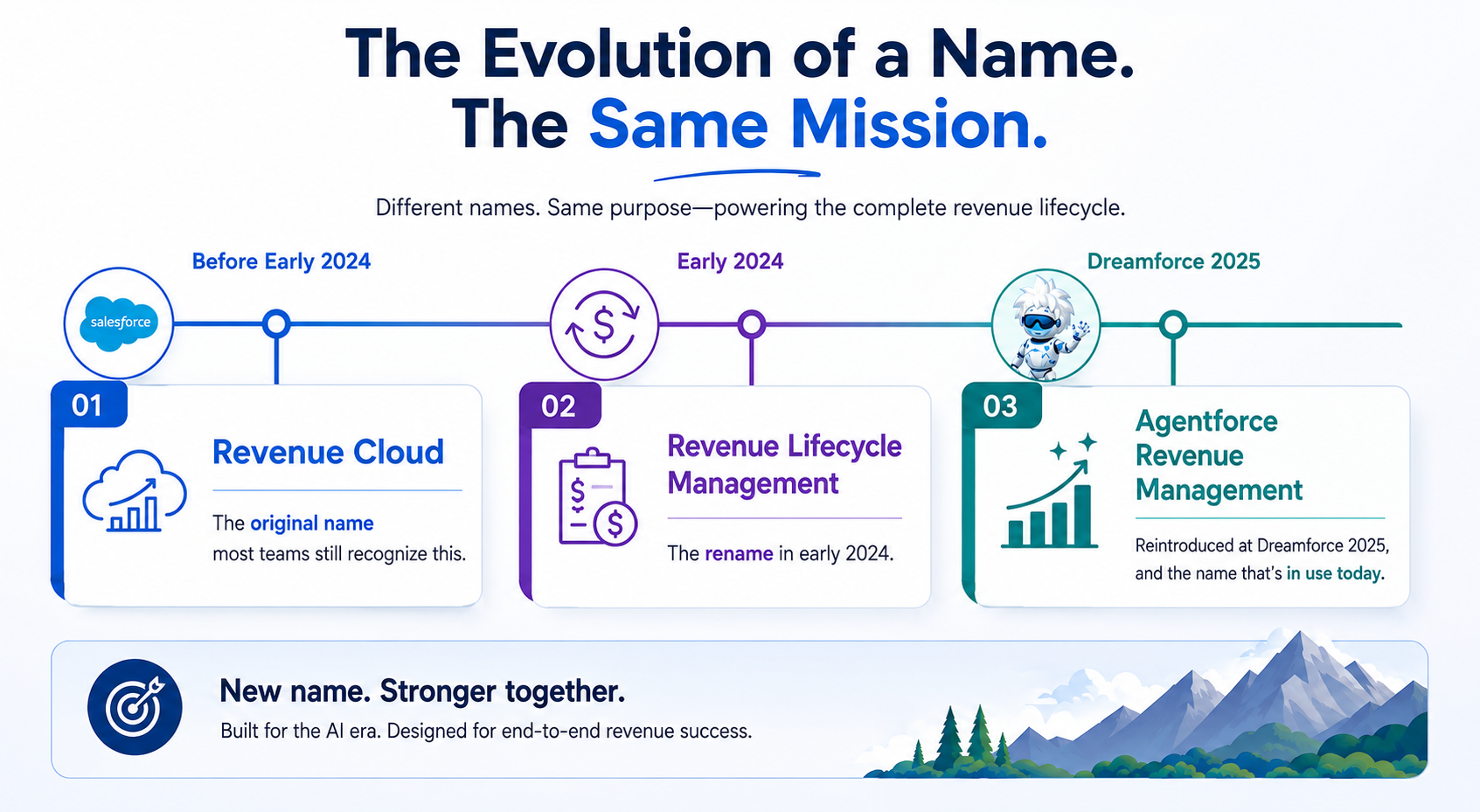
- Revenue Cloud, the original name most teams still recognize this.
- Revenue Lifecycle Management, the rename in early 2024.
- Agentforce Revenue Management, reintroduced at Dreamforce 2025, and the name that’s in use today.
They all have the same core platform underneath, and the rename is part of the company-wide shift from “Cloud” branding to “Agentforce”, the same move that turned Sales Cloud into Agentforce Sales.
The distinction that actually matters for your teams is between a copilot and an agent.
- A copilot suggests, drafts mails, recommends a next step, answers questions, and then waits for the humans to act on it.
- An agent acts, reads the data, applies the pre-set rules, and takes the necessary steps within its defined boundaries.
There’s an architectural point underneath the branding too, and it explains a lot of what follows next. Agentforce Revenue Management is built natively on Salesforce, with product, pricing, and billing data that lives under one unified model.
Legacy Salesforce CPQ was a managed package sitting on a separate data structure. That difference is why agents can act reliably on the new platform, and also why moving off the legacy CPQ is a real re-architecture rather than a simple license swap.
Agentforce agents don’t just recommend the next step. They’re built to take it. So how far you let go is a decision you actually make, and not simply a default you flip on.
The last point sets up everything below. Knowing where agents can act is only useful once you know where the manual work actually piles up.
Where Does Quote-to-Cash Slow Down? The Five Bottlenecks AI Agents Target
Quote-to-cash leaks time at the handoffs, the moment where work passes from one person or system to the next and somebody has to wait. Five of them show up again and again. Let’s understand them in depth below.
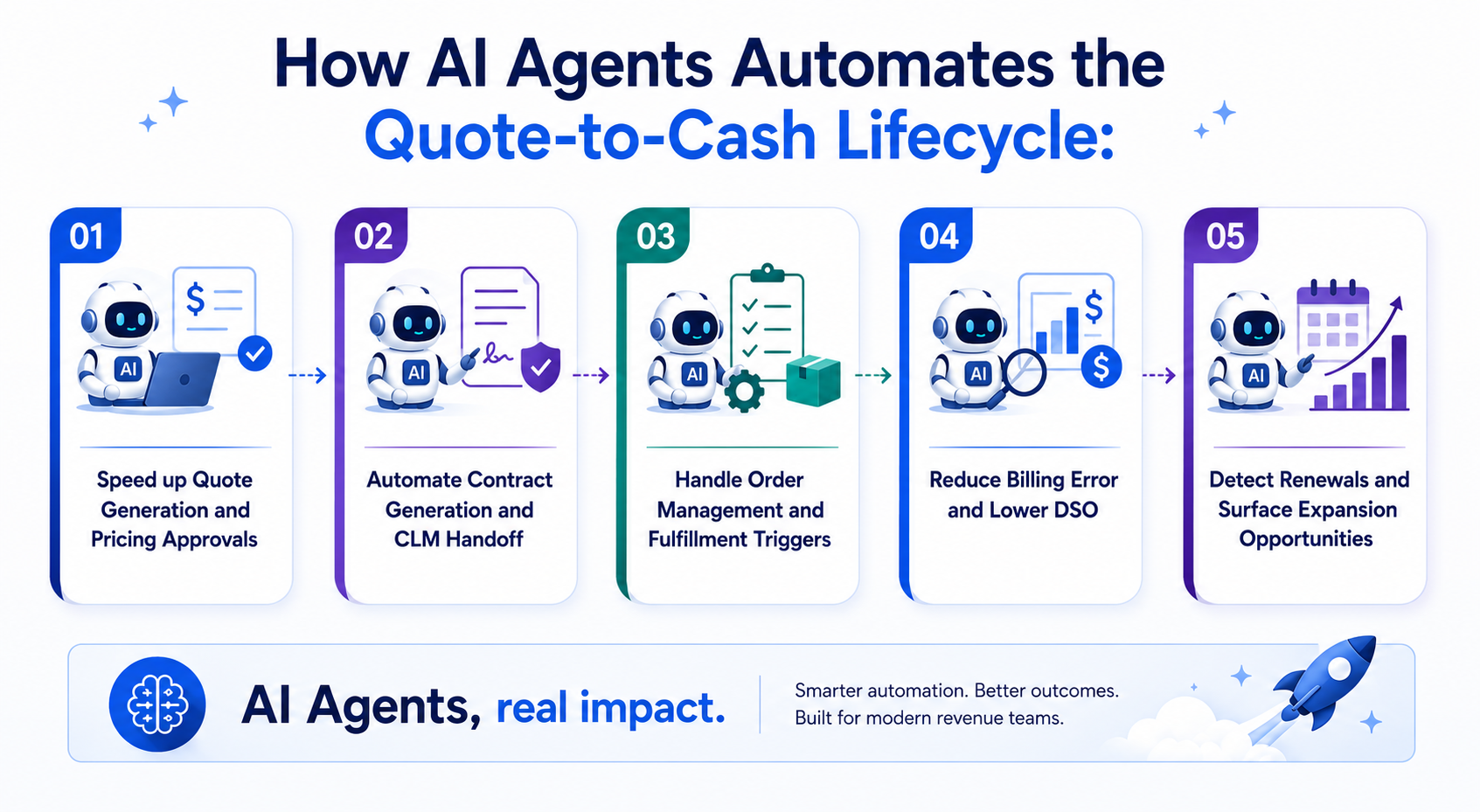
How AI Agents Automates the
Quote-to-Cash Lifecycle
1. Speed up Quote Generation and Pricing Approvals
2. Automate Contract Generation and CLM Handoff
3. Handle Order Management and Fulfillment Triggers
4. Reduce Billing Error and Lower DSO
5. Detect Renewals and Surface Expansion Opportunities
The sales rep hand-builds the quote, submits it to a multi-level approval chain, and waits. Standard deals sit in the queue behind the complex ones, deal desk drowns, and a quote that should take an hour actually takes three days.
Instead of sending another approval email into that queue, the agent:
- Reads the deal parameters and applies your pricing rules automatically.
- Clears the standard cases that fall inside your set thresholds and routes only the exceptions to a human.
The approval itself happens in Slack, where the approver gets an AI-generated quote summary, drills into line items, and approves or rejects in-channel, with the decision synced back to Salesforce and the audit trail intact.
The Outcome: The quote cycle compresses from days towards hours. The deal desk stops being the bottleneck and becomes a checkpoint. For an executive approver who rarely opens the CRM, the in-Slack decision alone removes days.
The sales rep emails the legal team. Redlines bounce back and forth. The deal cools while the paperwork catches up to a decision everyone already made.
What the agent does:
- Pulls the approved contract template and populates terms from the deal.
- Routes to legal only when a non-standard clause needs a human eye.
- Sends standard agreements straight to e-signature, no legal touch required.
Outcome: Legal’s time goes where it belongs. Forsys’ LexiShift accelerator handles the related problem of migrating legacy contract data, so historical agreements feed clean into this workflow instead of becoming a separate cleanup project later.
The deal is closed-won. It sits in CRM until someone keys the order into the ERP or order management system by hand. This is one of the quietest places revenue leaks, as nobody owns the gap between the systems.
What the agent does:
- Detects the opportunity close.
- Creates the order in Agentforce Revenue Management.
- Triggers the downstream fulfillment steps.
Outcome: The manual rekeying disappears, and the transcription error that used to ride along with it disappears too.
Finance runs a batch at month-end, where manual entry breeds errors. This triggers disputes that delay cash. Roughly 43% of credit based B2B sales in the Americas are overdue and invoice errors are the most common reason behind this delay.
What the agent does:
- Tracks entitlements and usage, then triggers billing events on schedule.
- Generates the invoice, logs it to the ERP, and flags the exceptions a human needs to see.
- Scores open invoices by payment history and recommends a risk-based follow-up plan, so the riskiest accounts get attention first.
Outcome: Fewer billing errors, lower days-sales-outstanding, and cash that slows up closer to when you earned it.
A CSM tracks contract end dates in a spreadsheet. The renewal discussion starts three weeks before expiry, which is about two months too late, and these signals get noticed only if someone happens to be looking at the right account on the right day.
What the agent does:
- Monitors contract milestones and fires the renewal workflow at 90, 60, and 30 days out.
- Surfaces expansion signals from actual usage.
- Drafts the renewal quote before the human picks up the conversation.
Outcome: The win gets captured by the system instead of it being done by someone’s memory. Of everything on this list, renewal and expansion detection is the most production-ready use case today.
Where Agentforce for Quote-to-Cash Isn’t Ready Yet?
There are three honest limits of AI Agents in 2026:
- No hands-off, end-to-end execution: Fully autonomous deal execution with no human in the loop is on the roadmap, not in production. Teams running live orgs are deliberately budgeting for incremental automation, not the keynote version where the whole pipeline runs itself.
- Agents inherit your data quality: Output is only as good as the data underneath. Inconsistent historical quoting data produces unreliable pricing suggestions, and it produces them fast. A messy catalog gets you wrong answers at machine speed.
- The ROI math doesn’t favor every deal: Highly bespoke deals, heavily regulated pricing, and low-volume enterprise sales where every deal is a snowflake are poor fits today. Repeatable, high-volume motions are where agents earn their keep.
What most vendors won’t mention:
The wins available right now are operational with faster deal-desk response, fewer missed renewals, lower ticket volume, and cleaner billing. The self-driving revenue engine in the demos is not what you’re buying in 2026, and any partner who tells you otherwise is selling you the slide, not the system.
With the boundary clear, here’s what the realistic version looks like when it all runs on a single deal.
What Agentic Revenue Operations Looks Like in One Deal
Follow a single deal moving from opportunity to renewal, and watch where the agent picks up the work a person used to carry.
The opportunity crosses 80% probability, and the agent triggers the quote configuration and applies the pricing rules. The standard discount clears automatically. The non-standard one it won’t touch, so that gets flagged, and a human approves or rejects it on Slack in a few minutes instead of a few days.
The quote is accepted. The agent generates the contract from the approved template and routes it for e-signature. After signing, the agent creates the order, notifies fulfillment, and the customer gets provisioned without anyone retyping a thing. Behind the scenes, the agent sets the billing schedule and starts monitoring usage.
Then it goes quiet, the way a good system should. Around day 305, the agent detects the renewal window opening. It drafts the renewal quote, pulls in the expansion signals it has been watching, and hands the whole package to the CSM with full context. Instead of wondering where the deal stands, everyone already knows. The CSM walks into the conversation prepared instead of scrambling.
A standard-quote turnaround that used to take about three days now takes only a few hours. Treat that as illustrative rather than a guaranteed benchmark; your mileage depends on your data and your rules.
The reassurance, once and clearly:
A deal only runs that cleanly if the groundwork is done first, and that’s where most of the project actually lives.
What You Need Before Deploying Agentforce for Quote-to-Cash?
Agents reward a clean data foundation and mess around with unorganized ones. Four things that are needed to be true before any go-live:
- A clean data foundation: Agents act at a machine speed, so on a messy product catalog, duplicate accounts, and disconnected pricing tables they produce wrong outputs at a very quick pace. Clean the data first, that might be the least glamorous part of the project, but that part decides whether everything works or not.
- ARM configured, off legacy CPQ: Agents run natively in Agentforce Revenue Management. On legacy CPQ or any other legacy system, migration comes first, and it’s a re-architecture rather than a license sweep. Forsys’s RevRamp exists to make this entire migration smoother, faster, and at lower-risk.
- Document agent boundaries: Which decisions are autonomous and which needs sign-off should be pre-written before the go-live and not after. This is governance, and not merely a technical checkbox.
- Change management: Reps need to understand what the agent does and trust it, or they’ll quietly route around it, and an agent workflow that nobody uses is just expensive software.
Get the basics right, and the deployment is the easy part. Skip even a single one, and even the best-configured agent in the world sits idle. If you’re not sure where your own org stands on these four, that’s exactly what a QTC Readiness Assessment is for.
Legacy CPQ vs Agentforce Revenue Management
If you’re weighing the move, this is the comparison that matters most.
| Area | Legacy CPQ | Agentforce Revenue Management |
|---|---|---|
| Architecture | Managed package on a separate data model | Native to Salesforce, unified data model |
| AI Agents | Not supported | Built in, agents act across the lifecycle |
| Product status | End-of-sale since early 2025 | Current, actively deployed |
| Pricing, billing & quoting data | Spread across structures | One unified model |
| Moving to it | N/A | Re-architecture and data migration, not a license swap |
| Best fit | Existing orgs still on support | Teams ready to automate repeatable QTC work |
Where Forsys Fits?
By this point one thing should be clear that with agentic QTC, the technology isn’t the hard part. The architecture underneath it is.
That’s the gap most teams hit, and it’s the one Forsys was built to close.
Forsys is a Salesforce, Conga, and Oracle partner with an AI Agents practice built specifically for revenue workflows. They specialize in the following:
- Assess whether your quote-to-process is actually ready for agentic automation.
- Migrate legacy CPQ and billing data onto a clean Agentforce Revenue Management foundation.
- Deploy agents across quotes, contract, billing, and renewal, scoped to what’s production-ready rather than what’s on a slide.
They frame this as a quote-to-cash transformation with measurable outcomes, faster cycles, fewer missed renewals, lower leakage, and not a generic AI engagement that produces a pilot and a press release.
Evaluating Agentforce for your revenue operations? Forsys offers a free QTC Readiness Assessment
The Entire Work Was Built for a Slower World
Manual quote-to-cash is a structural problem and not a people problem. The workflows were designed before this kind of automation existed, and they have been quietly taxing your teams ever since.
Agentforce is starting to absorb the connective tissue between quote, contract, order, billing, and renewal. It’s happening incrementally, with humans keeping all the judgement calls with them.
The teams that get the foundation right, the clean data and the clear governance, compound the advantage in the form of faster cycles, less leakage, and fewer renewals slipping through the cracks.
The real question isn’t whether AI agents will run parts of your quote-to-cash workflow. It’s whether your data and governance are ready for the data you let them.
Want to See What Agentic Revenue Operations Look Like For Your Business?