
As revenue organizations move beyond AI experimentation and toward AI-powered operations, a new challenge is emerging: can the platform underneath support autonomous decision-making across pricing, quoting, contracts, and billing?
For thousands of organizations still running Salesforce CPQ, the answer is increasingly no. The platform was built for a different era of revenue operations, long before AI agents became part of the workflow.
That reality is why Salesforce rebuilt its revenue platform from the ground up and launched Agentforce Revenue Management at Dreamforce 2025. This was not a product refresh. It was an architectural shift designed to support AI-native revenue operations.
For CROs, CIOs, and revenue transformation leaders, the important question is not "What is Agentforce Revenue Management?" It's "What does this shift mean for our business, and what happens if we delay?" This guide answers both.
Key Takeaways
- Agentforce Revenue Management is Salesforce's native, AI-agentic quote-to-cash platform — not a CPQ upgrade, but an architectural shift to a single native data model.
- The architecture shift from managed package to native Salesforce objects is what determines whether AI can operate inside your revenue lifecycle, not just beside it.
- Salesforce CPQ entered End of Sale on March 19, 2025. No new licenses or features are being sold — the forward path is Agentforce Revenue Management.
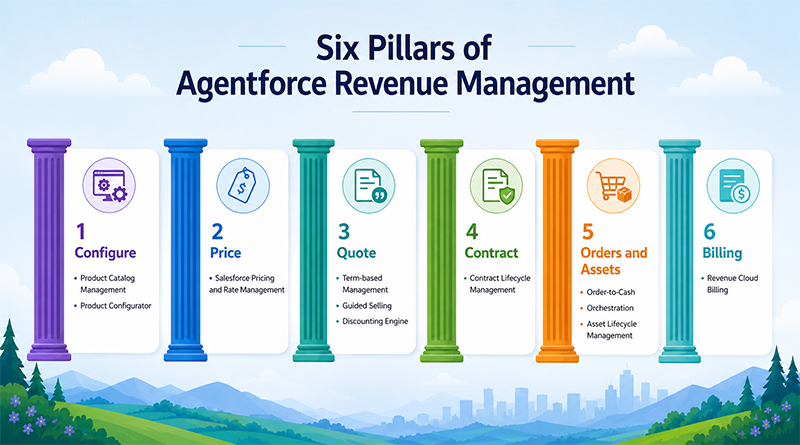
- The platform is organized across six pillars: Configure, Price, Quote, Contract, Orders & Assets, and Billing.
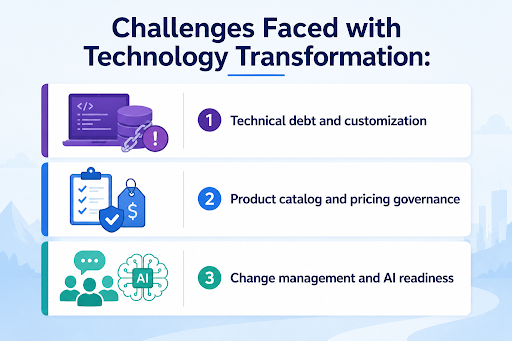
- Revenue transformation is harder than technology transformation — data quality, catalog hygiene, and change management cause more delays than the platform itself.
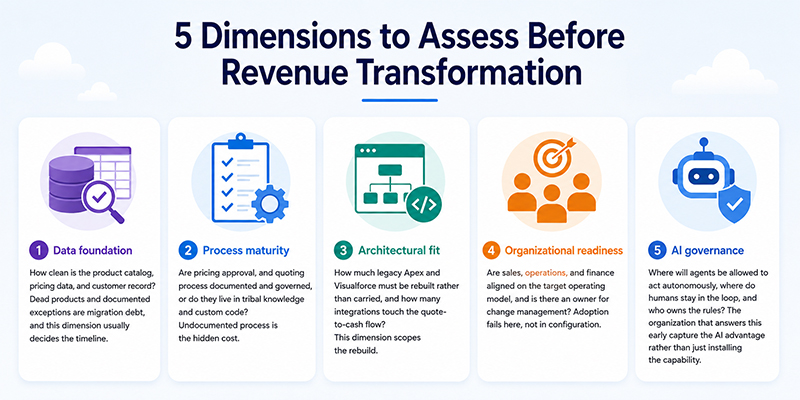
- The Revenue Architecture Readiness Model gives leaders five dimensions to assess before committing to a migration path.
- 2026 is the year to plan: an industry-wide migration crunch is forecast for 2027, and early movers get the talent and competitive advantage.
What is Agentforce Revenue Management?
Agentforce Revenue Management is Salesforce's native, AI-agentic quote-to-cash platform for complex revenue operations. It runs configuration, pricing, quoting, contracts, orders, assets, and billing on a single native data model inside the Salesforce core.
It was formerly Revenue Cloud, then Revenue Cloud Advanced (RCA), and briefly Revenue Lifecycle Management, before the Dreamforce 2025 rebrand.
The implication is the part worth holding onto. When pricing, quoting, contracts, assets, and AI agents all operate against one shared data model, the fragmentation that slows most revenue execution disappears. The disagreement between what sales quoted, what the contract says, and what billing invoices stops being a monthly reconciliation, because there is one source rather than three systems negotiating across integrations.
What it is
AI-agentic quote-to-cash platform running on core Salesforce native objects.
Formerly known as
Revenue Cloud → Revenue Cloud Advanced → Revenue Lifecycle Management → Agentforce Revenue Management (Dreamforce 2025).
Built on
Core Salesforce platform — native objects, pricing procedures, and direct integration with Data Cloud and Agentforce.
Best for
Mid-market and enterprises dealing with complex or recurring revenue — subscriptions, usage-based pricing, multi-channel, and long lifecycle deals.
Why the Architecture Shift Matters More than the Rename
Salesforce CPQ began as SteelBrick, acquired in 2015. For a decade it was the quote-to-cash backbone for thousands of enterprises. Legacy CPQ was a managed package — an external application on top of Salesforce with its own object model and performance ceiling.
Agentforce Revenue Management is native, built on core Salesforce objects and pricing procedures, connected directly to Data Cloud and Agentforce. That distinction determines whether AI can function as part of your revenue process or only sit beside it.
| Stage | Name | When |
|---|---|---|
| Original | Salesforce CPQ (SteelBrick) | Acquired 2015 |
| Rebrand | Revenue Cloud | Later branding phase |
| Brief Rename | Revenue Lifecycle Management | Spring 2024 |
| Native Rebuild | Revenue Cloud Advanced | Rebuilt on Salesforce objects |
| Current | Agentforce Revenue Management | Dreamforce 2025 |
An agent reasons well only when it can see pricing, contract, and asset data together. On a managed package that data was fragmented by design, which is why AI never felt native to CPQ.
The architecture decisions made during this migration determine your future AI capability. You are not choosing a quoting tool. You are choosing whether AI can operate inside your revenue lifecycle for the next decade. This is why every serious practitioner — including the SteelBrick founder — calls the move a re-platform rather than an upgrade.
How the Agentic Layer Changes Revenue Operations
The defining capability is an agentic layer across the revenue lifecycle, and it is where the business case lives. Traditional automation runs a fixed script — a rule fires the same way every time, regardless of context. The agentic layer reasons over context instead. It reads the live state of a deal, interprets intent, and carries the work forward while your team retains control of strategy, policy, and approvals.
In practice, agents do four things:
Observe live data
Reads real-time information from quotes, products, contracts, and billing records to understand where a deal stands.
Guide decisions
Recommends pricing, discounts, or terms based on your rules and historical patterns — before errors propagate downstream.
Take pre-approved actions
When authorized, generates quotes, amends contracts, triggers billing runs, or processes renewals without a person clicking each step.
Reduce repetitive execution
Routine work is handled by the agent, returning the revenue team to strategy, governance, and exception management.
The translation to operations is direct. Pricing becomes dynamic rather than quarterly. Quoting cycles shorten. Billing and renewals stay aligned to actual usage. Deal complexity that once demanded hours of hand-configuration stops taxing the team. Revenue operating teams are evolving from process enforcement to governance design — defining the rules that autonomous agents will follow at scale.
Six Pillars of Agentforce Revenue Management
Salesforce organizes the platform into six pillars spanning the quote-to-cash lifecycle. Each maps to a functional component, but what a revenue leader should read for is the operational outcome.
Six Pillars of Agentforce Revenue Management
Configure
Product Catalog Management, Product Configurator — attribute-based configuration for quotes past 1,000 lines.
Revenue teams launch and adjust faster — changing the catalog no longer means rewriting a thicket of custom rules.
Price
Salesforce Pricing & Rate Management — pricing procedures, decision tables, promotions across all channels.
Pricing adjustments become fast and auditable when the market moves, protecting margin instead of leaking it through manual overrides.
Quote
Transaction Management, Guided Selling, Document Builder — end-to-end quotation with AI-assisted suggestions.
Guided selling surfaces the right products and terms, so fewer rep errors resurface later as billing disputes.
Contract
Contract Lifecycle Management — AI clause generation, e-signature, negotiation-to-execution lifecycle.
Consistent terms and faster drafting cut the legal back-and-forth that quietly adds days to enterprise deals.
Orders & Assets
Order-to-Cash, Orchestration, Asset Lifecycle Management — fulfillment and full asset tracking.
Every product sold becomes a trackable asset — what makes clean renewals and usage-based billing possible instead of guesswork.
Billing
Revenue Cloud Billing — usage capture, invoicing, AR, and revenue recognition with full audit trail.
The loop from quote to cash closes with auditable records, so finance stops reconciling spreadsheets against the CRM each period.
Agentforce Revenue Management vs Salesforce CPQ
Both handle quoting and pricing, which is why they look similar. Nearly every difference traces to one root: CPQ was a managed package bolted onto Salesforce, and Agentforce Revenue Management is native. There is also a behavioral difference — CPQ evaluated commercial intent at quote time, and once the quote converted, that logic retired. Agentforce Revenue Management enforces revenue behavior across the whole lifecycle.
| Criteria | Salesforce CPQ | Agentforce Revenue Management |
|---|---|---|
| Architecture | Managed package | Native to core Salesforce platform |
| AI Capability | Limited or none | AI-agent powered |
| Billing Scope | Minimal, often needs a separate system | Full billing, AR, revenue recognition |
| Line-item Scale | Limited by package constraints | 1,000+ line quotes, nested, and ramp deals |
| Logic Boundary | Executes at quote time only | Enforces across the full lifecycle |
| Future Support | End of Sale — no new features | Active innovation path |
Licensing and Editions
The edition you choose determines how much of the revenue lifecycle you can modernize, and whether you are solving CPQ alone or rebuilding quote-to-cash entirely. The platform is modular, so buyers sort it into three lanes.
Salesforce does not publish pricing that supports clean planning, so online figures are unreliable. Real cost depends on edition, volume, add-ons, and contract structure. Before any AE conversation, settle these scoping questions:
- Do we need modern CPQ only, or also contracts, billing, and revenue recognition?
- Are we selling subscriptions, usage-based products, one-time products, or a mix?
- What must be native in Salesforce on day one?
- Will finance need invoice generation, usage invoicing, milestone billing, or receivables?
- Are we replacing legacy CPQ only, or redesigning the broader revenue lifecycle?
- What integrations must persist with ERP, tax, payments, or downstream finance?
Why Revenue Transformation is Harder than Technology Transformation
The single biggest predictor of whether a CPQ-to-Agentforce Revenue Management project succeeds is not the budget, the timeline, or even the partner. It is how well an organization understands what it actually has today — and most underestimate that by an order of magnitude. The migrations that fail expose everything the technology exposes.
The Revenue Architecture Readiness Model
The framework below gives revenue leaders five dimensions to score before committing to a migration path. It is deliberately platform-agnostic at the top and Salesforce-specific in execution. A low score is not a reason to wait — it is a map of what to fix first.
Revenue Architecture Readiness Model
1. Data Foundation
How clean is the product catalog, pricing data, and customer record? Dead products and undocumented exceptions are migration debt — this dimension usually decides the timeline.
2. Process Maturity
Are pricing, approval, and quoting processes documented and governed, or do they live in tribal knowledge and custom code? Undocumented process is the hidden cost.
3. Architectural Fit
How much legacy Apex and Visualforce must be rebuilt rather than carried, and how many integrations touch the quote-to-cash flow? This dimension scopes the rebuild.
4. Organizational Readiness
Are sales, operations, and finance aligned on the target operating model, and is there an owner for change management? Adoption fails here, not in configuration.
5. AI Governance
Where will agents be allowed to act autonomously, where do humans stay in the loop, and who owns the rules? Organizations that answer this early capture the AI advantage rather than just installing the capability.
The model tells a leader whether the organization is ready to start, and sequences the work so the hardest dimensions — usually Data Foundation and Process Maturity — are addressed before the build rather than discovered mid-flight.
This is exactly what RevRamp is built to run. Rather than a lift-and-shift that recreates old processes on new technology, it scores readiness across these dimensions, surfaces complexity early, and sequences the migration so risk is managed rather than encountered.
Who Should Use Agentforce Revenue Management?
The platform earns its cost when revenue is too complex for basic quoting tools and too important to run through disconnected systems. It is built for the full lifecycle — including subscriptions and consumption models — not for one-time quote generation.
SaaS Companies
Subscriptions, usage-based pricing, renewals, expansions, and amendments — all in one connected system.
Manufacturing & Hi-Tech
Configurable products, large quotes, channel complexity, and orchestration needs at enterprise scale.
Healthcare & Regulated
Tight control over contracts, approvals, and billing traceability across long lifecycles with compliance requirements.
You are likely ready if several of these hold: you sell more than simple one-time products, you manage renewals and amendments constantly, you need billing tied closely to CRM data, you have outgrown a point CPQ solution, quote errors are leaking revenue, or sales, operations, and finance run on different systems today.
Why 2026 is the Year to Plan Your Migration
If you are still on legacy Salesforce CPQ, 2026 is the year to start planning, and the reason is not a support cutoff. Salesforce has frozen feature development on CPQ, and the ecosystem talent and partners are concentrating on Revenue Cloud Advanced and the broader stack.
Industry analysts are already naming a 2027 migration crunch, when a wave of enterprises will move at once into a thinner talent market, at higher cost and higher risk.
The real deadline is competitive: AI-native pricing, guided quoting, and agent-assisted operations are becoming the baseline for RevOps maturity, and the gap between a frozen quoting system and an intelligent one compounds quarter over quarter.
Starting early leaves room for the hard parts: Reworking Apex and Visualforce, clearing ghost products and zombie rules, and adapting to new metadata types. None of that is a weekend project — it benefits from a structured approach rather than a forced march.
Migration is an infrastructure decision: The 12-to-18 month window opening in 2026 is not about beating an end-of-life date. It is about reaching AI-native revenue operations before the peers you compete with do.

Know your readiness before migrating from Salesforce CPQ to Agentforce Revenue Management.
RevRamp scores readiness across five dimensions, surfaces complexity early, and sequences a controlled migration — not a rushed one.
The Future of Revenue Management
The future of revenue management will not be decided by who writes quotes fastest. It will be decided by how well an organization orchestrates pricing, contracts, billing, assets, and AI-driven decisions across the entire lifecycle as one coherent system.
Agentforce Revenue Management is Salesforce's bet on what that future looks like. For the leaders who own this decision, the question has shifted. It is no longer whether revenue operations will become AI-enabled, because that is settled. The open question is whether the architecture you stand on can support it, and what it costs to answer that later rather than now.
Legacy CPQ will keep producing quotes for years. What it will never do is let AI operate inside the workflows where margin and velocity are won. The organizations that begin preparing this year will be scaling revenue innovation while competitors are still scoping it — and that head start compounds the longer it is held.