
For many enterprises, Salesforce CPQ is no longer the bottleneck. The years of customization built around it are.
What started as a flexible quoting solution has, in many organizations, become a rigid system propped up by layers of workarounds, undocumented logic, and brittle integrations.
Salesforce is investing heavily in Agentforce Revenue Management, a platform that brings together Revenue Cloud and AI-native capabilities to manage the full revenue lifecycle from CPQ through billing and asset operations.
Key Takeaways
- Legacy Salesforce CPQ is slowing enterprises down through technical debt, custom code dependency, and architectural limits that block AI adoption.
- Agentforce Revenue Management moves beyond quoting to manage the full revenue lifecycle, connecting CPQ, order management, billing, and asset operations under one platform.
- The architectural shift from custom objects to standard objects has direct implications for integrations, pricing logic, and data migration scope.
- Most migration projects stall because the starting point was not fully understood. Discovery is the highest-leverage investment in any migration program.
- AI-assisted tools like Forsys RevRamp compress discovery, mapping, and testing timelines, reducing both program risk and cost.
- Migration is a revenue transformation initiative. The systems change, but so do the workflows, the operating model, and how revenue teams work.
This guide covers what the migration actually involves: the business case, the process, the common failure points, and what enterprise revenue leaders should plan for before they start.
Why Revenue Operations Platforms are Being Rebuilt for the AI Era
The move from Salesforce CPQ to Agentforce Revenue Management reflects a broader structural change in how enterprise software is being redesigned around AI execution.
Across industries, revenue operations leaders are contending with a fundamental tension: the systems that manage revenue were built for human-operated workflows, but the competitive pressure to move faster is pushing organizations toward automation and AI-assisted decision-making. Those two realities are incompatible on legacy architectures.
Gartner projects that by 2028, 60% of B2B sales organizations will transition from experience-based to data-driven selling, shifting away from reliance on specialist sales reps. Revenue infrastructure that cannot support that transition becomes a strategic liability.
Three forces are accelerating this transition:
- Agentic AI is moving from experimentation into production across sales and revenue functions. Organizations are no longer asking whether AI can assist with quoting or approvals. They are asking which decisions AI agents should be allowed to make autonomously, and what governance structures need to surround that.
- Revenue operations consolidation is compressing the number of systems that sit between quote generation and recognized revenue. Enterprises that once accepted fragmented workflows across CPQ, order management, and billing are now demanding continuity.
- The cost of technical debt is becoming visible at the board level, as revenue leaders are increasingly asked to demonstrate how their operating infrastructure supports AI-readiness and scalability.
Salesforce's investment in Agentforce Revenue Management is a direct response to these forces. The platform is not a better version of CPQ. It is a rearchitected operating environment built for a revenue process that AI agents participate in, not just support.
For enterprise revenue leaders, the strategic implication is straightforward:
Before evaluating whether migration makes sense for your organization, it helps to understand exactly why this shift is necessary for your organization.
Why Are Enterprises Reconsidering Legacy Salesforce CPQ in 2026
The decision to migrate rarely comes from a single breaking point. It builds as the environment grows harder to maintain and the cost of standing still begins to outweigh the cost of moving.
Reasons Behind Switching Away From
Legacy Salesforce CPQ
Technical debt
accumulation
Heavy
customization
challenges
Maintenance
overhead
Slow quote
cycles
Fragmented
revenue operations
AI readiness
limitations
Scaling
challenges
Here are the key reasons why organizations are considering a shift:
The issue is no longer that CPQ cannot support quoting. The issue is that legacy CPQ architectures were designed for a human-operated revenue process, while modern revenue organizations are preparing for AI-assisted execution. That gap is what makes this a strategic decision, not just a technical one.
Before evaluating whether migration makes sense for your organization, it helps to understand exactly what Agentforce Revenue Management is and what it replaces.
What is Agentforce Revenue Management?
Agentforce Revenue Management is Salesforce's AI-enabled platform for managing the full revenue lifecycle. It combines Revenue Cloud's operational foundation with Agentforce's AI agent capabilities to give enterprise revenue teams a unified system for quoting, order management, billing, and revenue intelligence.
Revenue Cloud and Agentforce Relationship
Revenue Cloud provides the structural layer: product catalog, pricing engine, order management, billing, and asset tracking. Agentforce layers AI agents on top of that foundation to automate tasks and orchestrate workflows. They operate as one platform.
Revenue Lifecycle Management
Rather than treating quoting as the endpoint, Agentforce Revenue Management extends visibility through approvals, order processing, billing, renewals, and amendments. Teams that managed these steps across multiple systems can now work from a single source of record.
AI-Assisted Workflows
AI agents handle routine tasks within defined boundaries and flag exceptions for human review. This creates more consistent process execution across regions and deal types.
Unified Quote-to-Cash Operations
Quote generation, order processing, billing, and revenue tracking connect in a single operating model. Data does not need to move between systems. Handoffs are automated.
Revenue Intelligence
Stronger analytics give revenue leaders visibility into deal velocity, pricing performance, and operational patterns, so they can identify where the process creates friction before it compounds.
How does Agentforce Revenue Management differ from Salesforce CPQ?
The differences are architectural, not just functional. Several assumptions that hold in CPQ do not carry over.
| Area | Salesforce CPQ | Agentforce Revenue Management |
|---|---|---|
| Architecture | Custom-object heavy | Standard-object model |
| Core focus | Quote creation | Full revenue lifecycle |
| AI support | Limited or add-on | Native Agentforce integration |
| Billing | Separate workflows | Unified under one platform |
| Revenue visibility | Partial, quote stage only | End-to-end, post-sale included |
| Approval routing | Manual, rule-based | AI-assisted, dynamic routing |
| Scalability | Degrades under complexity | Built for 1,000+ line items |
| Integration model | Custom object dependencies | Standard API, cleaner handoffs |
The architectural move from custom objects to standard objects carries real migration implications. Integrations built against CPQ's custom object structures will need to be rebuilt. Pricing logic embedded in custom Apex code will need to be mapped to native configuration. These are not minor adjustments.
Knowing what the destination looks like is useful. But the more immediate question for most revenue leaders is whether their current environment has already crossed the threshold where migration is worth pursuing.
Signs Your Organization Should Start Planning a Salesforce CPQ Migration
Most migrations begin when the cumulative cost of staying on CPQ becomes visible. These are the patterns that signal the current environment is no longer serving the business.
Signs Your Organization Should Start
Planning a Salesforce CPQ Migration
Frequent pricing issues
Manual Quote Corrections required
Custom logic overload
Core logic relies on obsolete Apex
Slow product updates
Product launches delayed by weeks
Excessive exception approvals
Excessive exception approval handling
Integration limitations
Brittle, undocumented connections
Inconsistent quoting
Brittle, undocumented inconsistent pricing
Difficulty scaling globally
Difficulty scaling globally complexities
AI adoption blockers
Architecture blocks AI integration
When several of these patterns appear together, they rarely resolve on their own. Each one tends to compound the others.
Why delaying migration can increase complexity later?
Every quarter an organization delays migration is a quarter where the CPQ environment keeps growing. New customizations get added. More exceptions get built in. Dependencies multiply.
There is also the compounding cost of technical debt. Systems built on custom objects and manual processes do not become easier to maintain. They become harder. Revenue operations teams that defer migration often arrive at the starting line with fewer options and longer timelines.
The organizations that start migration planning now, even before committing to a full program, are the ones that arrive with a cleaner environment and a realistic scope.
Early assessment is cheap. Late discovery is expensive.
Once the decision to migrate is made, the next challenge is understanding what the process actually looks like and where programs typically run into trouble.
The Four Layers of CPQ Migration Readiness
Before committing to a migration timeline, enterprise revenue leaders need an honest assessment across four dimensions. Programs that enter without clarity on all four tend to discover the gaps at the worst possible moment.
- How deeply has the current CPQ environment been customized?
- How many custom objects, Apex classes, and automated flows are active?
- How much of that logic is documented?
- What is the state of the underlying data?
- Are product records clean and consistent?
- Are pricing structures complete?
- Are quote histories structured in a way that can conform to a new data model?
- Are the revenue workflows that CPQ currently supports well-understood and documented?
- Or have approval processes, pricing exceptions, and quoting standards accumulated informally over time?
- Is the organization prepared to define how AI agents will participate in the revenue process after migration?
Assessing these four layers before migration begins is what separates programs that finish on timeline from programs that extend.
Salesforce CPQ Migration Process
Successful migrations are structured as transformation programs, not technology projects. The goal is not to recreate the current CPQ environment in a new platform. It is to build a revenue architecture that can support future growth, automation, and AI-driven workflows.
Most enterprise migrations follow five phases:
Phase 1: Discovery and current-state assessment
Teams document product configurations, pricing logic, customizations, integrations, and data structures to understand migration scope and identify risks early. Discovery is often the highest-leverage phase because it determines the accuracy of every decision that follows.
Phase 2: Migration strategy and future-state design
Organizations decide what to migrate, retire, or redesign. The most successful programs use migration as an opportunity to simplify processes and eliminate legacy workarounds rather than replicate them.
Phase 3: Configuration transformation and data migration
Pricing rules, product structures, approvals, and integrations are mapped to Agentforce Revenue Management's standard-object architecture. Data quality remediation typically occurs alongside migration activities.
Phase 4: Testing and Validation
Teams validate pricing accuracy, approval workflows, integrations, and business-critical scenarios to ensure the new environment performs as expected before deployment.
Phase 5: Deployment and Operational Adoption
Go-live marks the beginning of operational adoption. Organizations that invest in enablement, governance, and post-launch support typically realize value faster than those that treat deployment as the finish line.
Even well-planned migrations run into friction. So, understanding where programs most commonly stall helps revenue leaders build programs that account for those risks rather than discover them midway through.
Common Challenges in Salesforce Revenue Management Migration
The complexity is rarely in the target platform. It is in the current environment. CPQ implementations accumulate technical debt over time, and that debt surfaces during migration in predictable patterns.
Why do many CPQ migration projects stall midway?
The most common stall point is late-stage scope discovery. Teams that compressed the discovery phase find undocumented customizations and integration dependencies during configuration. The rework required pushes timelines and consumes budget.
The second most common cause is data quality. When data remediation was not planned as a workstream, it surfaces as an unexpected delay. Records that cannot conform to the new data model create blockers that are expensive to resolve under pressure.
Most migration projects that stall do so because the starting point was not fully understood. Discovery is not a formality. It is the work that determines whether the rest of the program is credible.
This is where AI-assisted tools are changing the economics of migration, by compressing the phases where programs most commonly lose time.
How is AI Changing Salesforce CPQ Migration
AI is changing how migration teams work through the complexity of legacy CPQ environments. The traditional approach relied heavily on manual assessment: reviewing configurations by hand, mapping objects through documentation, validating logic through iteration. AI-assisted tools compress those timelines and surface risk earlier.
AI-Assisted Discovery
AI tools analyze CPQ environments to identify custom objects, automation dependencies, Apex code patterns, and integration touch points faster than manual review. Discovery that previously took weeks can complete in days.
AI-Assisted Mapping
Field mapping and pricing rule translation are time-consuming and error-prone when done manually. AI-assisted tools can suggest equivalences between CPQ structures and Agentforce Revenue Management's data model, flagging where the translation is straightforward and where human judgment is needed.
AI-Assisted Testing
AI can accelerate test coverage by generating test cases from existing CPQ configurations and comparing outputs across old and new environments at scale. This matters most for organizations with complex product catalogs where exhaustive manual testing is not feasible.
AI-Assisted Documentation
AI tools can generate dependency maps, configuration summaries, and migration reports that give teams a clearer picture of what they are working with and a more defensible record of migration decisions.
How RevRamp accelerates Salesforce CPQ migration?
RevRamp is Forsys's AI-powered accelerator built specifically for CPQ-to-Agentforce Revenue Management migrations. Where most migration programs lose time is in the early phases: assessment, mapping, and validation. RevRamp compresses all three.
Organizations that use RevRamp enter configuration with a clearer understanding of scope, which reduces the late-stage surprises that typically extend timelines and increase cost.
Teams spend less time untangling the current environment and more time making decisions about what to build. For enterprise programs that would otherwise run nine to twelve months, that compression changes the program economics meaningfully.
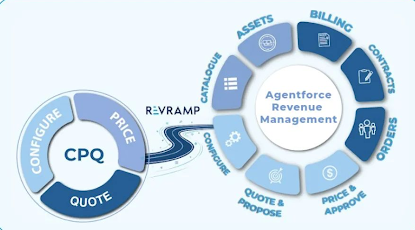
The broader point is this: CPQ migration is a revenue transformation initiative. The organizations that treat it that way, investing in structured discovery, rigorous data quality work, and deliberate operating model design, consistently outperform those that approach it as a technical lift-and-shift. RevRamp is built to support that approach.
With the migration process and tooling clear, the final question is where to start and what readiness actually looks like before a program begins.

Explore how RevRamp streamlines migration for your organization.
What Forsys Has Learned from Enterprise CPQ Migrations
After working through CPQ migrations across enterprise revenue environments, several patterns emerge consistently. These are not theoretical. They are observations from programs that succeeded and ones that stalled.
Five Lessons Enterprise Leaders Learn Too Late About CPQ Migrations
Most migration delays originate before migration starts: The decisions made in scoping, discovery, and data assessment determine whether the program finishes on time. By the time teams reach configuration, the timeline is largely set.
Data quality is a bigger risk than platform configuration: The target platform is well-documented and supported. The current data environment is not. Remediating legacy data under the pressure of a migration timeline is expensive. Remediating it before migration begins is manageable.
AI readiness depends more on architecture than AI tools: Organizations that want to use Agentforce capabilities fully need a clean, standard-object data model underneath them. Migrating technical debt into the new environment limits AI adoption just as much as staying on CPQ did.
Lift-and-shift migrations preserve the debt they were meant to eliminate: Replicating CPQ logic into Agentforce Revenue Management without redesigning it produces a new system with old problems. The migration window is the best opportunity to simplify. Most organizations that miss it regret it.
Operating model redesign drives more value than platform replacement: The platform enables better revenue operations. It does not design them. Organizations that define new governance structures, approval frameworks, and AI participation boundaries during migration extract significantly more value than those that treat it as a technology swap.
Preparing for the Next Phase of Revenue Operations
Migrating from Salesforce CPQ to Agentforce Revenue Management is less about lifting quotes into a new system and more about rebuilding revenue operations for the next phase of enterprise scale.
That means starting with an honest assessment of the current environment, not just its features, but its debt, its dependencies, and its limitations. It means designing for what revenue operations should look like in three years. It means planning for adoption with the same rigor applied to configuration and testing.
Revenue leaders who start that planning now, before the pressure of a hard deadline, will have more options and better outcomes than those who begin under duress.