
RevRamp is an AI-powered CPQ migration accelerator developed by Forsys. It helps move your product catalog, pricing rules, and quote data from a legacy CPQ system to Agentforce Revenue Management in just six to eight weeks, compared to the industry average of twelve-months, without any data loss.
Every RevOps leader running Salesforce CPQ is looking at the same calendar right now as Salesforce CPQ nears its end-of-sale date. The migration is no longer optional and the real variable left is how long it takes and what it breaks on the way.
Teams on other legacy CPQ are also watching the same clock, because the underlying problem here is identical: thousands of SKUs, years of pricing logic, and a sales team that cannot stop quoting while the migration happens.
This blog is for the ones making the actual decision. It walks through why the standard migration timeline runs a year, how RevRamp compresses that to six to eight weeks, and what proof exists that the compression doesn’t come at the expense of data integrity.
Why CPQ Migration is So Hard, and So Risky
A CPQ migration looks like a data transfer problem from the outside. However, inside the project it is much closer to reconstructing a live system while it still stays in use.
Five factors drive that difficulty, and each one is also a point where the migration can quietly fail:
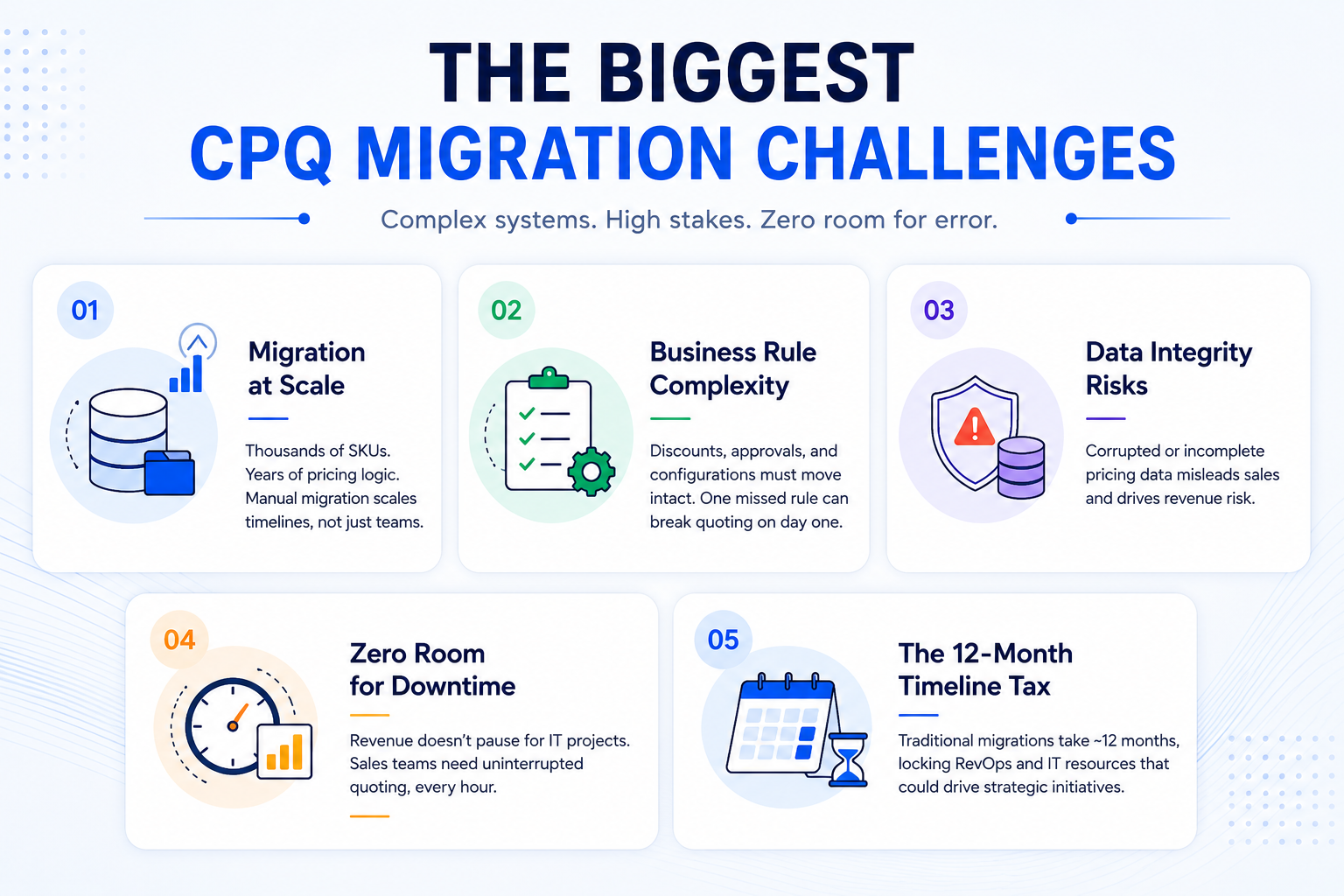
- Volume: A mid-size enterprise CPQ instance carries thousands of SKUs, years of pricing rules, and a full history of quotes that sales and finance both rely on for reporting. Rebuilding that by hand is not a resourcing problem you solve with more people. It is a timeline problem that scales with catalog size.
- Business-rule complexity: Discount logic, approval workflows, and configuration constraints have to survive the move intact. If a single approval threshold or discount tier gets dropped in translation, quoting breaks on the first day the new system goes live, and nobody notices until a deal is priced wrong.
- Data-loss risk: A CPQ system with corrupted pricing data actively misleads the sales team, which is a harder problem to detect and fix than an outdated system everyone already knows to double check.
- Downtime: Revenue does not pause for an IT project, so any migration approach that requires a clean break between old and new systems is asking the business to accept a gap it cannot afford.
- The timeline tax: A typical CPQ migration runs around twelve months, which means RevOps and IT are tied up on a single project for a year, unable to take on the next priority.
The barrier to CPQ migration was never the destination platform. It is safely moving the data and the rules into it without a year of disruption. That is the problem RevRamp was built to solve, and it is also the reason cpq migration without data loss has become the search query that matters most to this audience.
Once the risk is this well understood, the natural next question is what a purpose-built alternative actually looks like.
What is RevRamp?
RevRamp is an AI-powered migration accelerator that closes the gap described above. It is worth being precise about what it actually is before getting into how it works.
- RevRamp is a purpose-built CPQ migration accelerator, not a generic data movement tool retrofitted for the job.
- It automates the transfer of catalogs, pricing rules, quote history, and configuration data from a legacy CPQ system into Salesforce Agentforce Revenue Management, part of Revenue Cloud.
- Pre-built connectors mean there is no custom integration to scope or build before migration can start.
- RevRamp is Forsys intellectual property, deployed as part of a Forsys-led migration engagement rather than sold as standalone software.
Knowing what RevRamp is only answers half the question. The next section covers how it actually removes the risk described above.
How RevRamp Automates the Migration?
Four capabilities carry the weight of the six-to-eight-week timeline. Each one removes a specific point where manual migrations lose time or introduce risk:
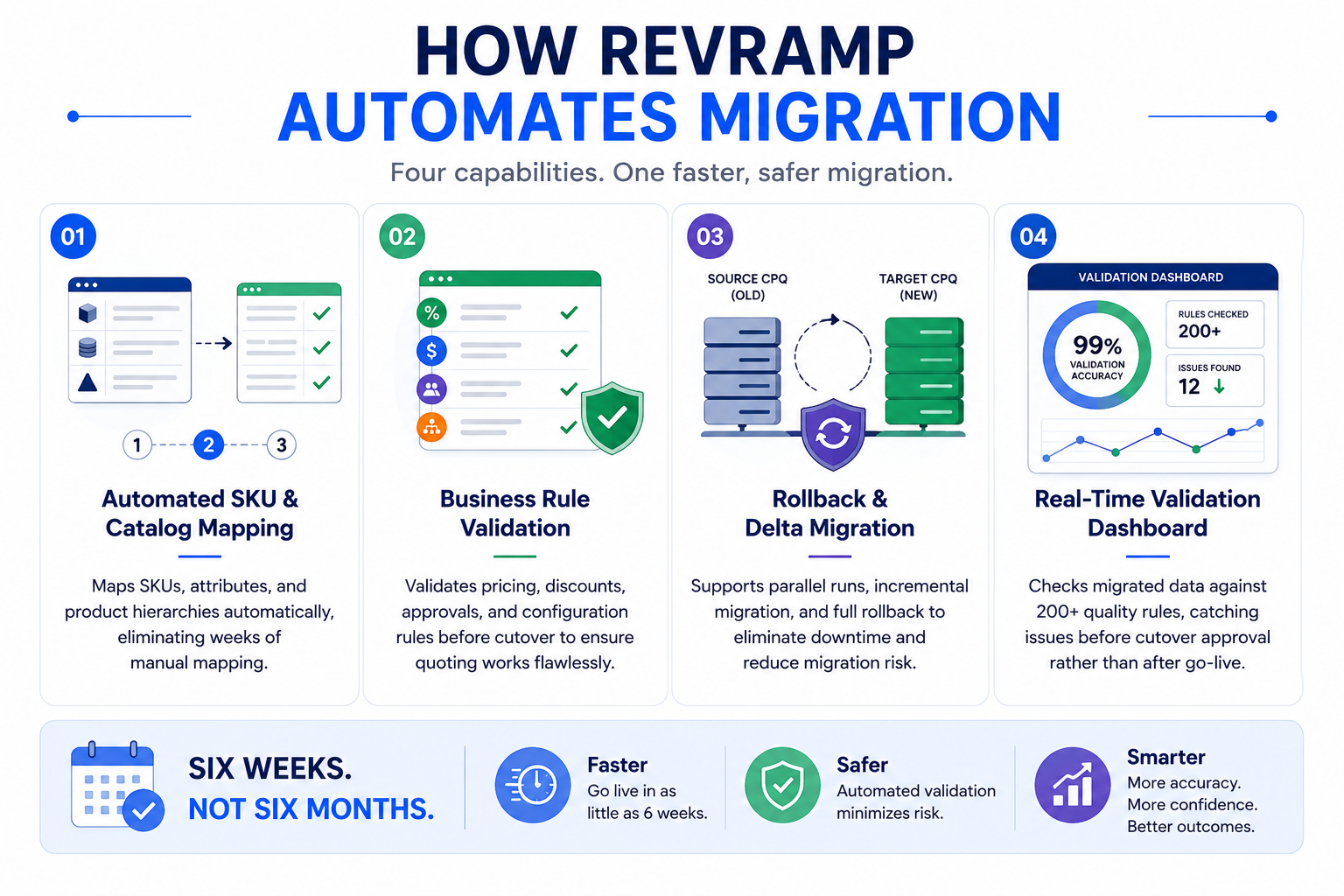
Automated SKU and Catalog Mapping
RevRamp reads the source catalog and maps SKUs, attributes, and product hierarchies to the target schema, with recommendations on migration sequence. Work that normally takes a team weeks of manual field-mapping happens as an automated first pass.
Business-Rule and Pricing Validation
Pricing logic, discount rules, approval workflows, and configuration constraints get translated and validated against the target system before cutover. Quoting behaves the same way after the move as it did before it, because the rules were verified rather than assumed to have been transferred correctly.
Rollback Safety and Delta Migration
RevRamp supports full rollback with complete operation tracking, along with delta and incremental migration. The old and new systems run in parallel through cutover, which removes the all-or-nothing risk of a big-bang switch and the downtime that comes with it.
Real-Time Validation Dashboard
A live dashboard checks the migrated data against more than 200 quality rules, catching issues before cutover approval rather than after go-live. This is what supports RevRamp’s 99% validation accuracy.
Takeaway: Mapping, rule translation, cutover, and validation are the four stages where manual migrations lose months and introduce risk. RevRamp automates all four and makes each one reversible, which is what makes a six-to-eight-week timeline safe rather than just fast.
That automation is what makes a six-to-eight-week calendar realistic rather than aspirational. Here is what that calendar looks like week by week.
The 6-to-8 Week Migration Timeline
The four capabilities above are not a single event. They run across four distinct phases, each with its own scope and exit criteria:
- Weeks 1 to 2, Assess and Map: RevRamp connects to the source system, auto-extracts the catalog and pricing rules, runs AI-driven field mapping, and produces a migration plan scoped to the specific instance.
- Weeks 3 to 4, Migrate and Preserve: Catalog, pricing, and quote data move into the target system while business rules get translated in parallel. Incremental loads run alongside the live source system rather than replacing it outright.
- Week 5 to 6, Validate: The validation dashboard runs its full rule set against the migrated data, flagged items get resolved, and the team runs user acceptance testing before sign-off.
- Week 7 to 8, Cutover: Go-live happens with rollback capability in place, followed by monitoring and handoff to the internal team.
Six to eight weeks against a twelve-month industry average is a 70% reduction in timeline, and it holds because the work that normally stretches across months, mapping, rule translation, and validation, is running in parallel and on automation rather than in sequence by hand.
See RevRamp on your own data.
Request a free migration assessment.
A timeline is only as credible as the results behind it. The numbers below are pulled from completed RevRamp migrations.
Proven Results
| Metric | Result |
|---|---|
| Records migrated | 23M+ |
| Data loss | Zero |
| Timeline reduction | 70% (6 to 8 weeks vs. approx 12 months) |
| SKU rationalization | 30,000 SKUs |
| Validation accuracy | 99% |
| Quality rules enforced | 200+ |
Those numbers only mean something in contrast. Here is the same migration run the manual way, side by side with RevRamp.
RevRamp vs Manual Migration
| Criteria | Manual Migration | RevRamp |
|---|---|---|
| Timeline | ~12 months | ~6 to 8 weeks |
| SKU and rule mapping | Manual, error-prone | AI-automated |
| Data-loss risk | High | Zero, validated |
| Cutover | Big-bang | Rollback-safe, parallel |
| Validation | Spot-checks | 200+ rules, 99% accuracy |
The comparison holds regardless of which legacy system you are migrating from. RevRamp was built to handle all the common ones.
Which Systems RevRamp Migrates From
RevRamp was not built around a single legacy platform. It was built to cover the systems most enterprises are actually migrating away from.
- From: Salesforce CPQ, Conga CPQ, Apttus, Steelbrick, Oracle CPQ, or a custom-built CPQ system.
- To: Salesforce Agentforce Revenue Management, within Revenue Cloud.
If your team is running any of these legacy systems, the migration path is already built rather than something that needs to be scoped from scratch.
Wrapping it Up
Salesforce CPQ’s end-of-sale status has already made migration inevitable for every team still running it. That removes one decision from the table. What is left is a choice between three concrete outcomes: a twelve-month manual project that ties up RevOps and IT for a year, a rushed migration that risks the pricing data the sales team depends on, or a six-to-eight-week accelerated path that has already moved more than 23 million records without losing one.
RevRamp exists to make the third option the default rather than the exception. The mapping, the rule translation, the parallel cutover, and the 200-plus validation checks are not shortcuts around the risk described earlier in this piece. They are the direct answer to it, built specifically because that risk is what stalls every CPQ migration that tries to run manually.
If your team is scoping this decision now, the fastest way to know what a six-to-eight-week timeline looks like on your own catalog is to run it against your own data rather than a case study.